
Technology has always transformed the way museums connect with their visitors. From the Théâtrophone in the 1880s to the audio guide in the 1950s, innovations have continually enhanced museum experiences. Today, chatbots powered by Artificial Intelligence (AI) are at the forefront of this digital transformation.
Since the early 2020s, museums have begun to harness the capabilities of large language models (LLMs)—AI systems designed to understand context, generate original content, and adapt to the unique needs of individual users.
Yet, the adoption of chatbots in museums represents more than just technological progress. To unlock their full potential, museums must look beyond the mechanics of AI and focus on understanding their visitors: Which topics spark their curiosity? What do they hope to learn? How does interacting with a chatbot shape their overall experience of the museum? Ultimately, conversational agents must do more than work effectively—they must „speak the language“ of their audiences, both literally and figuratively.
This post explores how chatbots are reshaping museums. It highlights innovative applications and addresses key challenges like trust, accuracy, and accessibility.
Definition and Evolution of Chatbots
A chatbot is a software application designed to simulate conversations with users, typically via text or voice. Chatbots are generally task-specific and designed for casual, often linear interactions. They are often used in customer service, FAQs, or simple informational exchanges.
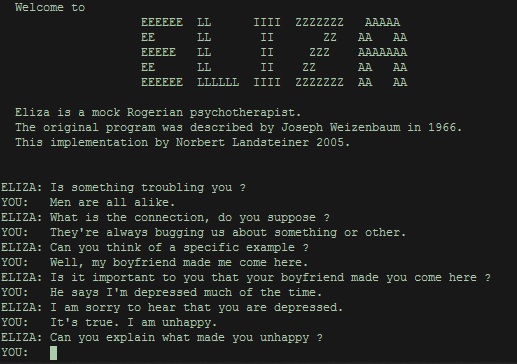
The history of chatbots began with ELIZA in the 1960s, which simulated basic therapeutic conversations using pattern matching and scripted responses. Systems like ALICE in the 1990s advanced this concept with AIML (Artificial Intelligence Markup Language). Virtual assistants such as Siri, Alexa, and Google Assistant in the 2010s brought conversational AI into daily life.
The introduction of large language models (LLMs) like OpenAI’s GPT in 2022 marked a new era of human-like interaction. With GPT-4 and similar advancements, a new type of chatbot evolved, that can engage in multi-turn, context-aware discussions, solving complex tasks and delivering a more human-like experience. These systems are far more sophisticated than early chatbots, making them powerful tools for museums.
Chatbots in Museums
Since the early 2000s, museums have experimented with chatbots to support visitors, providing practical information and playful, educational interactions. With the rise of LLMs, a new generation of conversational agents is emerging, reshaping how museums engage their audiences. Below are notable examples of this evolution.
Natalie Potter – The Met | 2024
Inside the exhibition Sleeping Beauties: Reawakening Fashion, visitors can chat with an AI-powered version of socialite Natalie Potter, who wore the Callot Soeurs wedding ensemble on display in the show. Visitors just have to scan a QR code to talk to AI-powered Natalie Potter through text. The program is based on a custom version of ChatGPT and trained on letters and historical documents of Natalie Potter. The experience was created in collaboration with OpenAI.
Te Papa – Museum of New Zealand | 2024
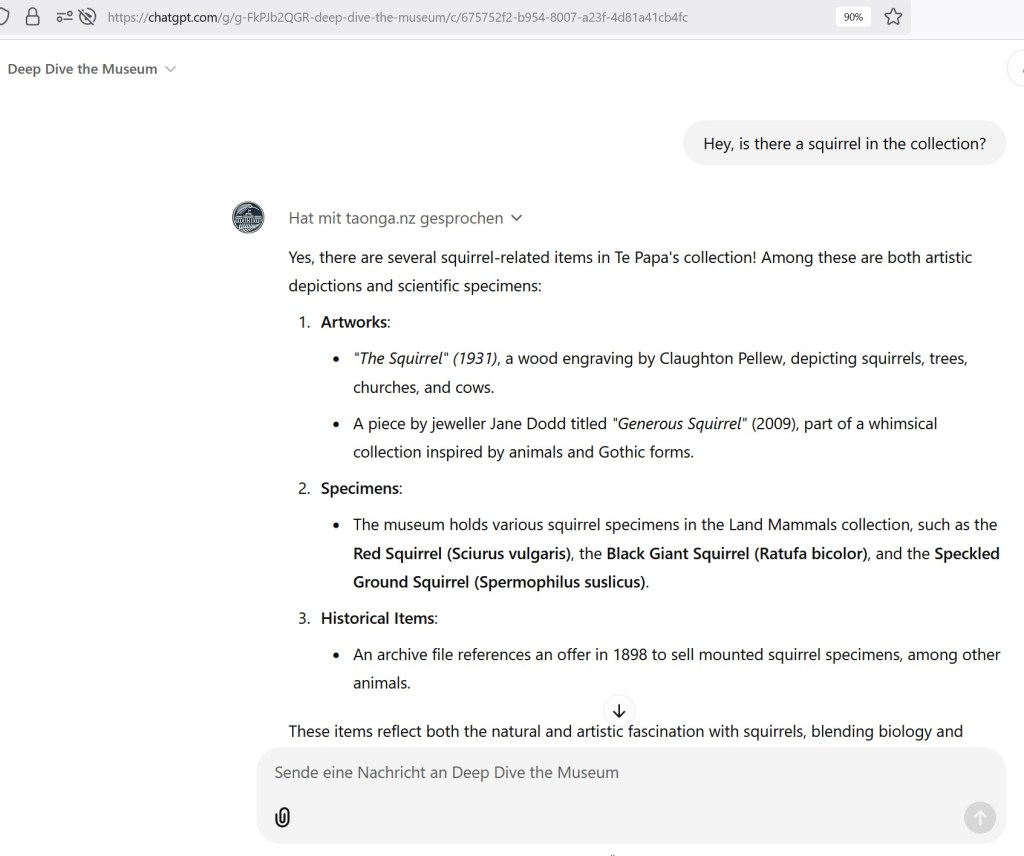
Te Papa’s experimental application, Deep Dive the Museum, uses ChatGPT to access its Online Collections. Instead of providing a list of search results, the AI summarizes content from the Online Collections and includes links to original source pages. This approach blends personalized exploration with transparency, allowing users to verify the information provided.
The Living Museum | 2024
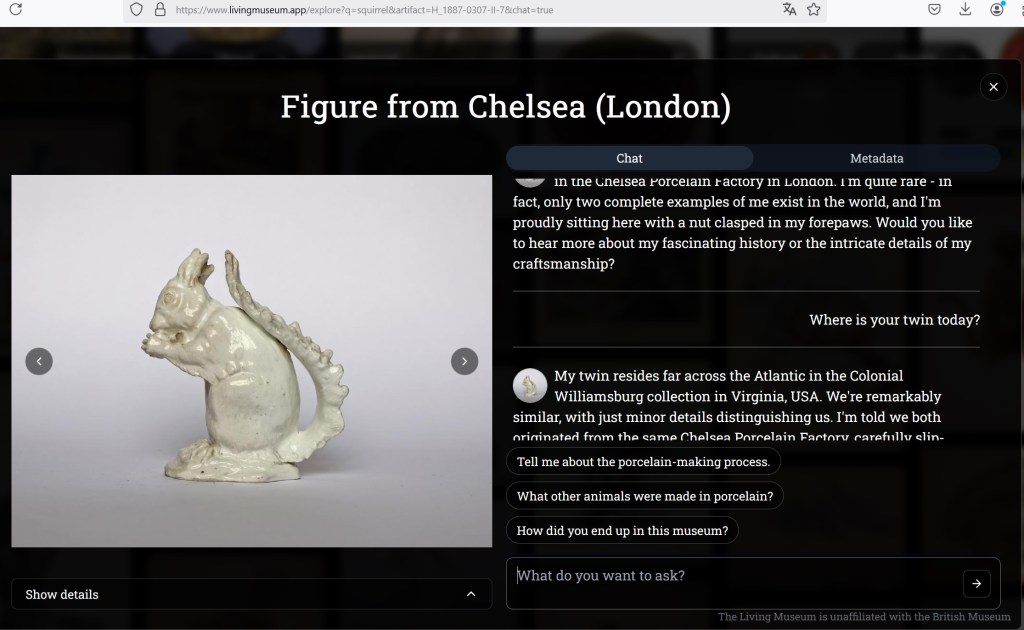
The Living Museum is an AI-powered project that allows users to interact with more that 1 million objects from the British Museums’ collection via an online platform. The project is not affiliated to the British Museum.
In addition to offering curated searches by period or object type, the system enables natural language queries and personalized explorations. It is actively proposing questions and topics to users to keep the dialog running. [Museums + Heritage Advisor: Chat with British Museum Objects 2024]
CHiM – Chatbot in the Museum | 2020–2022
CHiM (Chatbot in the Museum) was developed as part of a research project aimed at enhancing museum tours. The App allowed users to ask questions about artworks via touchscreen and voice interaction. CHiM handled factual questions as well as open-ended questions, which posed a more significant challenge for chatbot systems at that time. The prototype was tested at the Städel Museum in 95 sessions, covering 13 selected artworks.
The chatbot utilized the BERT language model—short for Bidirectional Encoder Representations from Transformers—a machine learning (ML) model for natural language processing (NLP). Additionally, it incorporated Retrieval-Augmented Generation (RAG) for answering queries, leveraging the museum’s databases and audio resources to generate answers. [Interaktive Technologien; Gustke et al. 2023; Städel Stories 2021;]
Femme Fatale – Kunsthalle Hamburg | 2023
In 2023, Kunsthalle Hamburg launched a chatbot as part of the exhibition Femme Fatale. Blick – Macht – Gender. Users could interact with six femme fatales through automated chat in the museums app. The program was based on IBM Watson technology, a cognitive system that uses artificial intelligence to learn content from various sources, including videos, photos, interviews, and audio.
Voice of Art – Pinacoteca Sao Paolo | 2017
In 2017 the Pinacoteca Sao Paolo partnered with IBM to develop The Voice of Art, a voice based app to ask questions about seven artworks in the museum.
The app operated with IBM Watson technology. Watson was fed information about Brazilian art history, the selected paintings, and their contexts for six months. To train the chatbot, an internal website was developed where collaborators typed questions related to seven selected artworks. This process generated over 1,750 questions. These questions were then organized into 326 distinct intents. This organization provided a solid foundation for training the system.
Send Me SFMOMA | 2017–2020
Send Me SFMOMA is open source software. It was developed by the San Francisco Museum of Modern Art. The software replied to text messages with keywords like “love” or “flower” with a corresponding art work from the collection. For doing so, it searched the digitized collection by descriptive words (the tagging has been done manually). Over three years, the service delivered 6,422,646 artworks to users. [SFMOMA Announcement 2020]
From House To House – Milan House Museums | 2017
The From House to House game was introduced to attract new audiences to Milan’s four House Museums. Users engage with an avatar on Facebook Messenger (or Telegram messenger) to explore the museums‘ treasures. The treasure hunt is still active in 2024 and accessible via a code provided at the museums‘ ticket offices.
Anne Frank House, Amsterdam | 2017
In 2017, the Anne Frank House developed a chatbot for Facebook Messenger. The bot allowed users to „speak“ with Anne Frank, learning about her life and the Holocaust. The chatbot also offered practical information such as opening hours, ticketing, and directions. [Anne Frank House News 2017; ZKM Report]
Object Phone – Cooper-Hewitt Museum, NY City | 2013–2016
The Cooper-Hewitt Museum was among the first institutions to experiment with chatbot technologies. In 2013, it launched Object Phone, a voice-based system powered by Twilio technology, designed to answer visitor questions about museum objects. Later, an optional subscription feature allowed users to receive daily messages about selected objects. They could also pose related questions to the chatbot. Complex or unanswered questions were forwarded to museum experts who provided personalized responses. [Cooper Hewitt Labs; Github.com; Charr 2019]
ASK – Brooklyn Museum, NY City | 2015–Present
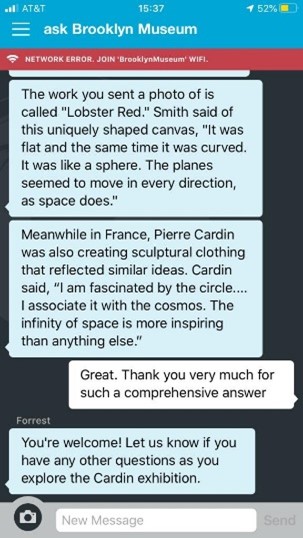
The ASK Brooklyn Museum app enables museum visitors to ask questions about artworks via a chat feature. Unlike AI-powered chatbots, responses are provided by human art experts, ensuring personalized and in-depth answers. The App can be considered a human based forerunner of chatbots and AI driven conversational systems in museums. [Forum Kulturvermittlung]
Visitor Questions and Engagement with Chatbots
Many chatbots in museums allow visitors to ask questions directly to or about artworks. But what do visitors want to know? Barth et al. (2020) analyzed 142,463 conversation logs from 5,242 sessions of The Voice of Art, a voice-based chatbot at the Pinacoteca in Brazil. The study found that visitors’ questions fall into three categories (Barth et al. 2020):
- Meanings and Intentions Behind Artworks: More than half of the questions explored the deeper meanings or purposes of the pieces on display, indicating a desire for interpretive insights.
- Factual Information: Questions about the artworks‘ creation, historical context, and provenance were common.
- Artist Details: Visitors frequently inquired about the creators’ lives, influences, and careers.
Interestingly, the study revealed that these patterns of inquiry were consistent regardless of the artwork’s style, medium, or physical placement in the museum. Chatbots that effectively address these core topics enhance the visitor experience, providing relevance and satisfaction. Conversely, irrelevant or off-topic answers detract from the interaction.
Enhancing User Experience Through Interaction Design
The way visitors interact with chatbots—whether through text or voice—can significantly influence their overall experience. Schaffer et al. dicovered in their study of the CHiM chatbot trial at the Städel Museum, that speech-based interactions were perceived as more engaging, creative, and dynamic compared to touch inputs. Highly important to the overall user satisfaction is in this context the perceived quality of the chatbot’s speech output. (Schaffer et al. 2024)
Another important factor is the program’s ability to engage visitors playfully while still delivering valuable insights. For example, the Living Museum employs a humorous tone that keeps conversations lighthearted and enjoyable, while seamlessly guiding users back to educational content. This blend of entertainment and information boosts user satisfaction and encourages longer interactions.
While speech quality plays a pivotal role in shaping positive experiences (Schaffer et al. 2024), the impact of natural language processing (NLP) accuracy— such as response precision and conversational flow—requires further research. A promising area for future development is designing conversational agents that not only answer questions effectively but also initiate thoughtful inquiries, fostering a more reciprocal and immersive dialogue with visitors.
Balancing Trust and Innovation: Challenges for Museums
While conversational AI offers immense potential, their implementation raises critical challenges:
- Data and Training: Chatbots and conversational agents need accurate, comprehensive data to function effectively. Museums must identify the most relevant questions visitors ask and ensure the answers are grounded in credible, well-researched sources.
- Authorship and Trust: When a chatbot or conversational agent responds, who is truly speaking—the museum, the AI, or both? Museums must carefully manage the authorship of chatbot content to avoid inaccuracies, hallucinations or bias that could harm their reputation as trusted institutions. To guarantee trust and accuracy, museums can adopt several best practices. These include developing rigorous content-review processes, leveraging expert oversight for responses, and clearly indicating the sources of information provided by the programs.
- Accessibility and Inclusivity: Chatbots should cater to diverse audiences. They should offer multilingual support and both text and voice options. Accessibility features are essential for visitors with disabilities.
By addressing these challenges, museums can balance innovation with the trust they have built over centuries.
The Future of Conversational Agents in Museums
The success of AI-powered chatbots and conversational agents in museums depends on their thoughtful implementation. Museums must prioritize not only technological capabilities but also a deep understanding of audience needs and expectations. Continuous visitor studies and user feedback are essential for aligning these tools with visitor interests. Identifying and employing the most effective user feedback mechanisms remains a critical area for further exploration.
To fully harness the potential of this technology, museums are encouraged to carefully address challenges such as trust, accuracy, and accessibility. These efforts will support enhanced visitor experiences and ensure that chatbots serve as reliable, engaging tools. Ultimately, these systems must align seamlessly with the institution’s mission: to connect audiences with art, history, and culture in ways that are engaging, accessible, and trustworthy.

Sources
- Ashri, Ronald (2017): How Museums Are Using Chatbots. Chatbots Magazine
- Barth et al. (2020): Intentions, Meanings, and Whys: Designing Content for Voice-based Conversational Museum Guides. CUI ’20, Bilbao, Spain
- Candello et al. (2000): Understanding How Visitors Interact with Voice-Based Conversational Systems. Design, User Experience, and Usability, 40-55. DOI: 10.1007/978-3-030-49760-6_3
- Charr, Manuel (2019): How Are Museums Using Chatbots? museumnext.com
- Gustke / Schaffer / Ruß (2023): CHIM—Chatbot in the Museum. Exploring and Explaining Museum Objects with Speech-Based AI. Transcript Open. DOI: 10.14361/9783839467107-024
- IBM: Was sind Chatbots? IBM Chatbots
- Med-AI: ELIZA Chatbot. Med-AI ELIZA
- Rocha Veiga, Ana C. (2022): The Voice of Art: IBM Watson Artificial Intelligence at a Brazilian Museum
- Schaffer et al. (2024): Chatbot in the Museum – A Field Study of User Experience and Modality Usage. Elektronische Sprachsignalverarbeitung 2024, Tagungsband 2024
- Štekerová, Kamila (2022). Chatbots in Museums: Is Visitor Experience Measured? Czech Journal of Tourism, 11(1-2), 14-31. DOI: 10.2478/cjot-2022-0002.
- Styx, Lauren (2024): How Are Museums Using Artificial Intelligence? museumnext.com
- Thiel, S./ Bernhardt, J. (Ed.) (2023): AI in Museums. Reflections, Perspectives and Applications. Transcript. DOI: 10.14361/9783839467107
- ZKM-Report: Talk to Me: Chatbots in Museums
 Forum Kultur Vermittlung
1 Kommentar zu „How AI Chatbots Transform Museum Experiences“